Turkish Music Therapy | Latest Articles by Lisa England
This page archives reflections on Turkish makams as medicine; the work of Dr. Rahmi Oruç Güvenç; and the therapeutic effects of sound from the Central Asian, Ottoman, and Sufi traditions. Most recent content appears first. All articles can be read on Substack.
4 April 2026
The Jewish Sufi Pilgrim Podcast | Season 1 Episode 2
The Path and the Place:
Kabbalistic and Sufi conceptions of spiritual journey, rupture, and return
I’ve received some very understandable responses from readers. Namely: “Why would someone like you write about topics related to Sufism — and specifically the music therapy work of a Mevlevi sheikh?” The phrase “someone like you” seems to be a polite euphemism for my Jewish identity. It’s a reasonable question, given the way modern religio-civilizational identities have come to be constructed rather rigidly, often in response to each tradition’s past traumatic encounters with The Other.
25 March 2026
Musical Process as Medicine
Active music therapy for the devotional instrumentalist.
One of the most powerful qualities of music is its capacity to open a portal for us — a doorway into a different dimension of consciousness, or into parts of ourselves we rarely access: parts that are more peaceful, more connected, less agitated.What happens when you become the instrument of your own music therapy? Or surrender to the healing medicine of your own sound? More than you might think possible … even if you’re relatively new to your instrument.
16 March 2026
The Jewish Sufi Pilgrim Podcast | Season 1 Episode 1
Why this eclectic podcast concept? It all begins with a story...
In this opening episode of The Jewish Sufi Pilgrim, I introduce the spiritual crossroads that shaped my journey from evangelical Christianity to Judaism, and into the study of Islamic Sufism, sacred sound, and Turkish music therapy. This episode introduces the idea of a “liminal geography” — a place where distinct spiritual traditions remain intact yet encounter one another in curiosity and reverence.
11 March 2026
Why a Jew Would Write About Sufi Therapeutic Sound
It's not as strange as modern religious narratives would have us believe
Why would a Jewish convert spend her time researching and writing about historical music traditions that are often considered ‘Islamic’? It’s a question I’ve been asked more than once — and it’s a reasonable one, given the way modern religio-civilizational identities have come to be constructed rather rigidly, often in response to each tradition’s past traumatic encounters with The Other. But to be honest, the question is only really relevant within the framework of the last few centuries.
8 March 2026
The Jewish Sufi Pilgrim | Trailer
Welcome to a podcast between the shul and the shrine
A new journey begins today. Welcome to a podcast between the shul and the shrine — a joyful exploration of the shared spiritual and musical worlds in Jewish and Islamic mysticism. While this Substack is primarily dedicated to Turkish Music Therapy, the discipline itself emerged within the overlapping historical sound worlds of the wider Central Asian region — many of which are rooted in mystical ideals and devotional traditions. The podcast therefore takes a broader perspective ...
3 March 2026
Translation as an Act of Love
On the Holy Creation Process of Listening Across Languages
This past week, I finished translating the first in a series of 175 Sohbetler (Spiritual Conversations) given by Dr. Rahmi Oruç Güvenç. Though, to say that I “did the translation” is not entirely accurate. I oversaw a process carried by tools, then checked and re-checked by other tools, and finally sifted by my own ear and attention. My aim is simple and stubborn: to hear every recorded word in Oruç Baba’s voice and grasp his teachings in my first language, English. I do not call this desperation. I call it determination. Or, if you prefer the Sufi frame, an act of love.
19 February 2026
Makam Medicine
The Living Architecture of Turkish Music Therapy
When we speak of Turkish Music Therapy, it is easy to become absorbed in the romance of regional history and culture and overlook the fact that this is a potent set of technologies deployed for a specific healing purpose. Makams are a primary way that healing occurs. This brings us to a foundational question: What are makams, and how do they function? If Turkish Music Therapy is to be taken seriously as a therapeutic system, we have to understand its architecture, which exists in part through makams. This first essay in a series lays the groundwork. The rest will build from lived experience.
15 February 2026
Overview of Turkish Music Therapy
Core materials, methods, and instruments
Dr. Rahmi Oruç Güvenç is widely credited with reviving and shaping the contemporary transmission of Turkish Music Therapy, a traditional discipline rooted in the classical music systems of Anatolia and the wider Islamic world. The foundations of this tradition, as transmitted by Güvenç, lie in the makam system—a modal framework in which melody, rhythm, and progression are understood to carry distinct qualitative and affective properties. Medieval medical and philosophical sources describe the use of specific makams in relation to temperament, time of day, emotional state, and physiological balance, emphasizing attentive listening as a primary mode of engagement rather than performance alone.
13 February 2026
About the Listener
Who's walking the path here with you on Substack?
This work is written by me, Lisa England. My life and practice have unfolded along nomadic lines, shaped by long periods of movement across countries and cultures, and by a recurring, unavoidable question: Where is home? For those who live this way long enough, the question ceases to be philosophical. It becomes practical, spiritual, and embodied. It is the central question of my life. And at a critical moment in this life, as I returned to a nomadic path after a period of rootedness, Dr. Rahmi Oruç Güvenç stepped forward as an ancestral voice.
11 February 2026
Opening the Head, Softening the Heart
Why reflection and music belong together
In Turkish Music Therapy, Central Asian healing lineages, and Tasavvuf, the head (kafa) is not the enemy of the heart. It is one of its portals. Dr. Rahmi Oruç Güvenç expressed this plainly in a sohbet (teaching conversation) given in Ankara on 10 January. Speaking about the effects of music on perception and awareness, he said: "We have found that there are mind-opening possibilities. Now, let us do an exploratory [music therapy] practice on this matter..."
9 February 2026
Tassavuf, Kalbin Yolu, and the Inner Work of Initiation
Sufism, Love, and the Music of the Heart
If the first work of nomadic music is regulation, its deeper work is initiation. This initiatory function is best seen the musical culture of Tassavuf (Islamic Sufism) which arose both adjacent to and also out of the nomadic musical cultures of Central Asia, and the makam music of the Ottoman Empire. Tasavvuf does not arise from settled certainty, doctrinal rigidity, or abstract theology. It emerges from lived encounter — with love, loss, longing, impermanence, and the limits of control. For this reason, Sufism has historically flourished within nomadic and circulatory cultures, where uncertainty is not an anomaly but a given. Within Tasavvuf, love and uncertainty are inseparable.
7 February 2026
Remembering Rahmi Oruç Güvenç
Sound, trust, and the restoration of a living lineage
Dr. Rahmi Oruç Güvenç (1948–2017) was a Turkish lineage holder of Tasavvuf (Islamic Sufism), a baksı (Central Asian shamanic practitioner), musician, composer, ethnomusicologist, music therapist, and poet. But more than this, his students remember him as an İnsan Kamil—a realized human being—not because he claimed spiritual authority, but because he embodied inner coherence and unconditional love.
7 February 2026
Ground Precedes Path
Finding orientation within Turkish Music Therapy
Many people from Western backgrounds encounter Turkish Music Therapy, Sufi music, or Central Asian healing traditions through fragments: a rhythm, a chant, a historical anecdote, a technique. What is often missing is orientation — a sense of why these musical lineages exist, what kind of human being they were shaped to serve, and what inner capacities they are meant to cultivate. With orientation, the music can be received as it was intended: as a living system of nervous system regulation, inner healing, and companionship with the Real.
7 February 2026
An Opening
The landscape we are listening into
Merhaba ve hoş geldin (Hello and welcome) to the Turkish Music Therapy Substack: a place to explore the power of sound, woven through culture and planted in the soil of Central Asia — tempered by time and tradition into a therapeutic modality trusted by generations of nomads and sultans, later fragmented, then remembered for a new generation by the recent work of Dr. Rahmi Oruç Güvenç. The musical traditions gathered here arise from circulatory worlds: Central Asia, Anatolia, Persia, the Ottoman sphere: regions shaped for millennia by nomads, semi-nomads, travelers, mystics, traders, healers, and pilgrims.
About the author
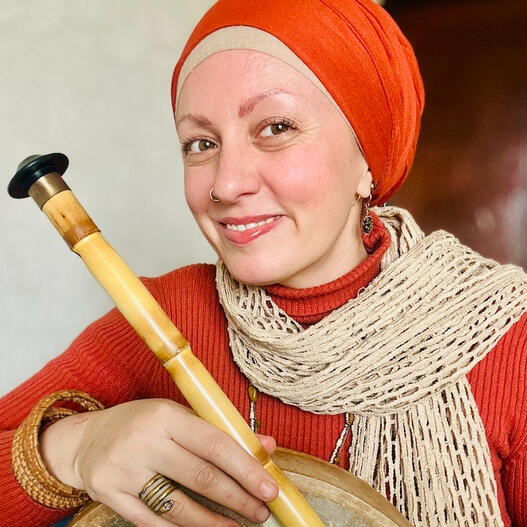
All articles on the Turkish Music Therapy website and Substack are written by Lisa England, a writer, musician, and independent scholar of Desert Devotion and Migratory Sound, who follows migratory lineages of music across the Middle East and Silk Road. Her work explores intersections where the region’s many spiritual traditions meet through voice and instrument, influence one another, and reveal deeper continuities beneath their distinctions.Currently, she is focused on music as medicine across medieval Central Asia and the Ottoman world, with particular attention to voices and healing practices often overlooked in modern transmission — such of those of Jews and women mystics. She honors the legacy of Dr. Rahmi Oruç Güvenç as a spiritual guide in this work, and a steward of medicinal music traditions from Türkiye and the Silk Road.
© 2026 by Lisa Walker England. All rights reserved.